| Radon: The Invisible Enemy | | |
RiskWhat Is Radon?
Radon is a colorless, odorless, and tasteless radioactive gas that forms during the radioactive decay of uranium and thorium, which are naturally present in the Earth’s crust. This harmful gas enters the atmosphere through the Earth’s surface and can spread into the air,  water, and soil. One of the main concerns regarding radon is its ability to seep into homes and buildings through cracks, crevices, and other openings in foundations, walls, and floors, accumulating indoors and reaching dangerous concentrations.
A particularly alarming aspect is that exposure to radon is a significant risk factor for the development of lung cancer. The International Agency for Research on Cancer (IARC) has classified radon as a human carcinogen, and it is estimated to be responsible for approximately 22,000 deaths per year in the United States.
There are preventive measures we can take to reduce exposure after measuring radon levels in the building, so that we have a clear understanding of the risk. If radon levels are high, you can install an adequate ventilation system to reduce the buildup of this gas indoors. It is essential to follow the recommendations of your doctor or the relevant authorities to limit radon exposure and protect your health.
Factors Here are some factors that can increase the risk of radon exposure:- Geographic location: Living in an area where the soil is rich in uranium can lead to higher levels of radon in the environment;
- Home construction: A house with concrete or brick foundations may allow radon to penetrate into indoor spaces;
- Poorly ventilated spaces: Basements or cellars can promote the accumulation of radon in enclosed spaces; a lack of proper ventilation in the home contributes to the buildup of radon indoors;
- Building materials: Some building materials can release radon, such as certain types of granite;
- Other sources: Radon gas may enter homes through water, natural gas, or methane lines.
- Direct contact with the ground: When a building’s foundation rests directly on the ground, radon emissions can more easily penetrate living spaces because they are in direct contact with the soil.
- Building structure: Direct connections between the building and underground spaces with poor air circulation, or construction using contaminated materials, increase the likelihood of high radon gas concentrations.
- Granitic or volcanic soils: Homes and offices built on granitic soils or soils rich in tuff are more likely to have high radon concentrations, as are buildings located near volcanoes (active or inactive).
If one or more risk factors are present, it is advisable to conduct a radon screening.
Radon Exposure Limits The reference levels for the average annual concentration of radon activity in the air have been set as follows: 300 Bq/m³ for workplaces and existing homes, and 200 Bq/m³ for homes built after December 31, 2024.
The critical locations where radon measurements should be taken are as follows:- Underground or basement rooms,
- Ground-floor rooms located in priority areas for reducing radon gas concentration levels,
- Specific types of workplaces to be identified in the National Radon Action Plan,
- Spa facilities.
Operators will be required to repeat measurements every eight years and in conjunction with extraordinary maintenance, restoration, conservation, and building renovation work involving structural changes at ground level. In addition, measurements must also be taken in the event of work aimed at improving thermal insulation.
These measures have been introduced to ensure the safety and health protection of workers exposed to radon in various work environments. It is essential to carefully monitor radon levels in workplaces and homes and to take appropriate measures to keep the concentration of radon activity in the air below the established reference limits.
Radon Presence in Italy
In Italy, radon gas is widespread, posing a significant threat to homes and offices in various regions of the country. The highest concentrations are found primarily in Campania, Friuli-Venezia Giulia, Tuscany, Veneto, Piedmont, Aosta Valley, and Lombardy. Lombardy, in particular, has areas with notably high radon levels, especially in the provinces of Sondrio, Como, Brescia, Bergamo, Varese, and Lecco.
However, this does not rule out the presence of radon gas in other regions that might seem less affected, including areas of southern Italy. The geological makeup of our territory and variations in geological characteristics facilitate the easy spread of radon gas. This occurs through the transport of water and methane and due to the presence of the gas within the building materials used in structures.
Reducing Indoor Concentrations There are several measures, some of which are simple, to reduce radon gas concentrations inside buildings.- Ventilate the rooms—Perform this practice regularly to facilitate air circulation and promote the dispersion of radon gas into the surrounding environment. Simply open the windows fully for 2–3 minutes, or, alternatively, keep them slightly open in the tilt-and-turn position for 5–6 minutes.
- Seal cracks and crevices—This practice helps limit the entry of radon into the home or office, reducing any potential gas penetration.
- Waterproof the ground-floor slab—Especially in buildings where the foundation is in direct contact with the ground, waterproofing the floor is an effective method for significantly reducing radon gas infiltration.
- Install a CMV system - The definitive solution often involves installing a Controlled Mechanical Ventilation (CMV) system when natural ventilation through doors or windows is insufficient. Air extraction devices can be used to remove contaminated air from areas such as basements and cellars. This practice promotes better air exchange and helps reduce the concentration of radon and other pollutants commonly found indoors: formaldehyde, volatile organic compounds, combustion byproducts, dust, carbon monoxide, etc.
Relevant Legislation Legislative Decree No. 101 of July 31, 2020, is the current legislation implementing Directive 2013/59/Euratom. This law repeals and replaces the previous legislation concerning protection against ionizing radiation. The objective of this new legislation is to ensure more effective and up-to-date protection against ionizing radiation, taking into account the latest scientific knowledge and European guidelines. Legislative Decree No. 101 of July 31, 2020, introduces stricter safety measures and controls to protect the health of people exposed to such radiation and to prevent the risks arising from their exposure. This law represents a significant step forward in the protection of public health and the responsible management of sources of ionizing radiation.
Download our guide in PDF format  Radon: The Invisible
Enemy |
| | Corentium Radon Detectors | |
C.B.A. Chimica Biologia Ambiente offers rental services for electronic samplers manufactured by Corentium to measure radon exposure. With this radon detector, you can independently conduct long-term measurements of the concentrations of this harmful gas. The device provides daily average values as well as medium- and long-term averages.
The Corentium radon detector is battery-powered and is lightweight and easy to use, allowing it to be easily placed in various areas within homes or workplaces to detect radon concentrations in the air. Unlike conventional technologies, which require more technical expertise, this device makes it easier to detect the presence of radon in different environments over a specific period.
By using the radon detector, users can independently conduct a screening to identify any critical areas where radon may accumulate and take appropriate countermeasures. The radon detector is easy to use and requires no special measurement skills, as once activated, the device automatically takes readings.
It is important to follow certain guidelines to obtain accurate measurements. We recommend not mounting the detector on a wall to avoid skewing the readings. It is best to position it with the display facing upward, following the guidelines provided by most national radiation protection authorities. Additionally, it is advisable to use the device in rooms in direct contact with the ground and to place it at least 25 cm from the nearest wall, 50 cm from the floor, and 150 cm from ventilation openings.
If high radon levels are detected, it is strongly recommended to conduct a more thorough analysis with the assistance of experts in the field. Consulting qualified professionals is essential for identifying the causes of the problem and implementing appropriate and effective solutions. High levels of radon pose a health risk; therefore, acting promptly and relying on qualified specialists is essential to protect yourself and the occupants of the affected area. | Technical
Specifications - Alpha spectrometry as the method for detecting Rn -
Selection of different measurement ranges -
Maximum display value: 9999 Bq/m³ -
Durable construction -
Battery life exceeding 2.5 years -
Maximum measured value: 35,000 Bq/m³
—Radon detection method: passive diffusion chamber—
Radon measurement method: alpha spectrometry—
Sensitivity:
1-day average measurement ~1.3 pulses/hour at 100 Bq/m³
7-day average measurement ~0.3 pulses/hour at 100
Bq/m³- Accuracy:
Short-term < 20% after 7 days at 100 Bq/m³
Long-term < 10% after 1 month at 100
Bq/m³- Absolute accuracy < 5%
- Power supply: 3 x 1.5
AAA batteries - Power consumption: 250
mW - Dimensions: 120 x 69 x 22.5 mm 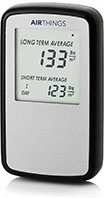
- Weight: 130 g (batteries included)
- Operating
conditions temperature: 0 ... +40 °C
relative humidity: < 95% RH-
Measurement
range 0 (below detection limit)
9999 Bq/m³ (maximum display value)
35,000 Bq/m³ (upper device limit)
- Data
memory 1-hour time resolution: 7 days
2-hour time resolution: up to 80 days
24-hour time resolution: 80 weeks | | | |  |  |  | | |
| |


